
Toyota's official factory recruitment site is one of the most detailed employer pages we have ever read. It publishes the daily wage, the bonus at every contract milestone, the dormitory fittings, the shift times to the minute, even how many days you can be absent before losing a payment.
And on the one question you came here with, it says nothing at all.
We scanned all sixteen official pages for every relevant Japanese term. Nationality: zero results. Residence status: zero. Permanent resident: zero. Visa: zero. Foreign: zero. Japanese language: zero. For comparison, the phrase "period employee" appears 110 times, so the search was reading the pages correctly.
That silence is the honest centre of this article, and we will come back to what it means. First, what Toyota actually does publish, because it is genuinely worth knowing.

What This Job Actually Is
The programme is called kikan jugyoin, period employee. It is not agency work and not a dispatch contract. You are hired directly by Toyota Motor Corporation on a fixed term, and the recruitment site at t-kikan.jp is genuinely Toyota's own, carrying its copyright and linking to Toyota's corporate privacy notice.
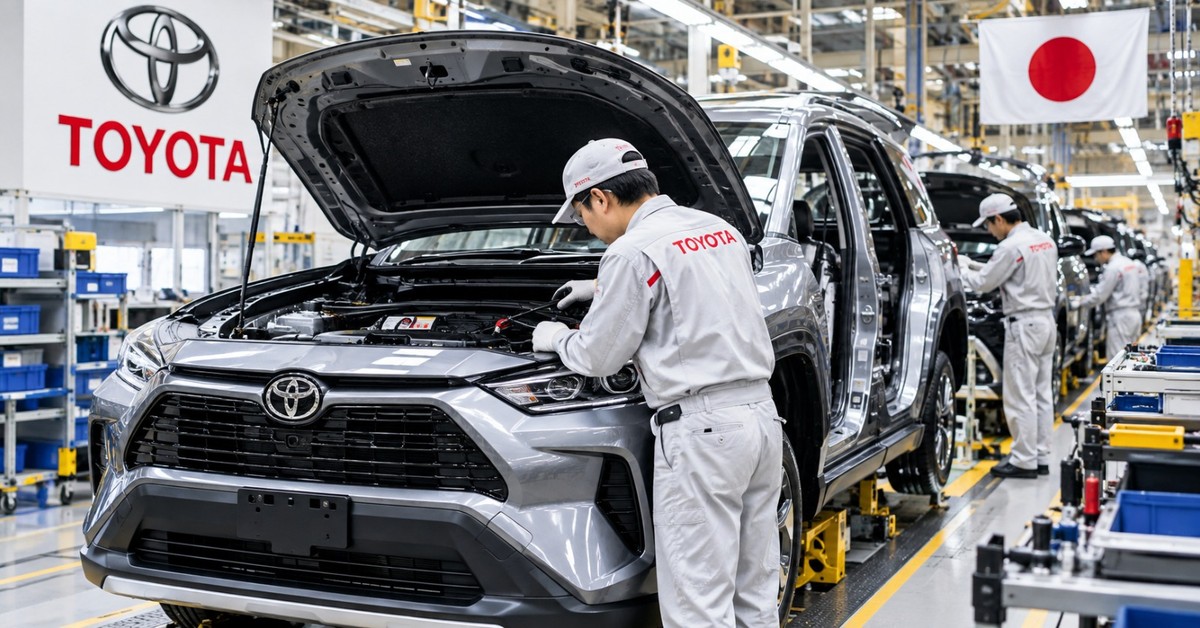
The nine processes are press, casting, body, painting, molding, machine assembly, logistics, vehicle assembly and final inspection. One line on the official site is worth quoting because it surprises people: you cannot choose your process. Assignment follows an aptitude test and whatever the plants need.
The Eligibility List Is Two Lines Long
Most articles pad this out. Toyota's actual published requirements are only these two:
- Aged 18 or over and able to work the three-month term.
- Able to do standing and line work in a factory on a continuous two-shift schedule.
That is the complete list. "No experience necessary" is not one of the requirements, although it is true — Toyota states elsewhere that about 6 in 10 period employees join with no previous experience, and training is given.
Where You Will Be Sent
Aichi Prefecture, and nowhere else. Toyota states the workplace is decided by the company, and that it will be one of ten plants: Honsha, Motomachi, Kamigo, Takaoka, Miyoshi, Tsutsumi, Myochi, Shimoyama, Kinuura and Tahara.
Two corrections to what circulates elsewhere. Kariya is not on the list — it appears nowhere on the official site. And Miyoshi, Myochi and Shimoyama are in Miyoshi City, not Toyota City, so the common summary "Toyota City, Hekinan and Tahara" misses a city where three of the ten plants sit.
Also worth knowing: Toyota Motor Kyushu, Toyota Motor Hokkaido, Toyota Motor East Japan, Toyota Motor Hamura, Toyota Auto Body and Daihatsu all hire their own period employees separately. This programme will not send you to any of them, and neither will it send you to Teiho.
The Nine Processes, and Why You Cannot Pick One
Toyota publishes exactly which production areas period employees are assigned to. They are not interchangeable, and the physical demands differ a great deal:
- Press — stamping body panels from sheet steel.
- Casting — molten metal work, the hottest environment on the list.
- Body — welding and joining the shell.
- Painting — coating lines, with the protective equipment that implies.
- Molding — forming plastic and resin components.
- Machine assembly — engine and powertrain component work.
- Logistics — moving parts and materials to the lines.
- Vehicle assembly — the final line, fitting components into the car.
- Final inspection — checking finished vehicles before they leave.
Toyota states plainly that you cannot choose your own process. Assignment follows an aptitude test and whatever the plants need at the time. If you have a physical limitation that rules out heat, height, or repetitive overhead work, raise it at the interview rather than hoping for a particular line.
Toyota's Wider Japanese Plant Network
Toyota's own Japanese manufacturing footprint is much larger than this programme, and conflating the two is the most common mistake in articles on this subject.
Toyota's eleven directly operated plants are Honsha, Motomachi, Kamigo, Takaoka, Miyoshi, Tsutsumi, Myochi, Shimoyama, Kinuura, Tahara and Teiho.
Its affiliated manufacturers include Toyota Motor Kyushu, Toyota Motor Hokkaido, Toyota Motor East Japan, Toyota Auto Body, Daihatsu Motor, and — newly — Toyota Motor Hamura, a wholly owned subsidiary in Hamura City, Tokyo that began operating on 1 April 2026 with roughly 5,060 staff, taking over the former Hino Motors plant.
Here is the part that matters: every one of those affiliates recruits its own period employees separately, and none of them is reachable through t-kikan.jp. Neither is Teiho. Daihatsu in particular is a separate company with its own brand and its own hiring, not a "Toyota factory" you can be posted to. If you want Kyushu or Hokkaido, you apply to that company directly.
Toyota also announced in August 2025 that it plans to acquire land in the Teihoucho area of Toyota City for an entirely new vehicle plant, with operations planned for the early 2030s and models undecided.
The Money, With the Assumptions Included
Toyota publishes a basic daily wage of JPY 11,150 to JPY 12,450, with the higher figures for people who have completed previous Toyota terms. That number is unconditional, and it is the one to plan around.
The headline figures need their footnotes. Toyota's monthly example of JPY 316,580 to JPY 353,500, and its first-year estimate of about JPY 5.6 million or more, both assume a two-shift roster with:
- 21 working days in the month,
- 20 hours of overtime,
- 35 hours of night-work allowance, and
- 78.25 hours of shift-differential allowance.
That last item is left out of almost every article we checked, and it is doing a lot of work in that total. This is a figure for someone working a full, heavy roster every month, not a base salary.
Completion money, and how you lose it
Toyota pays a completion bonus at each milestone: JPY 390,400 at 6 months, JPY 488,000 at 12, JPY 512,400 at 18, JPY 536,800 at 24, JPY 561,200 at 30 and JPY 576,000 at 35 months. Over a full term that totals JPY 3,064,800.
The condition is severe and it is published: if you leave part-way through a contract, you are paid none of it. Part of it, the reward element at JPY 1,500 a day, is also only paid for months with no absence, lateness, early leave or leave of absence.
The JPY 1,000,000 campaign, and why you must check the date
Toyota is currently advertising a special payment totalling JPY 1,000,000: JPY 400,000 with your second month's salary, and JPY 600,000 on completing the six-month contract.
Both halves have absence conditions — five days for the first, eight days across six months for the second. And the offer carries this line in Toyota's own words: "Limited to those joining from September 2026 onward. The period is subject to change."
This is a promotion, not a permanent term of employment. If you are reading this months after publication, assume it has changed and check the live page.
Other allowances
- Relocation allowance JPY 30,000, paid about two weeks after starting.
- Experienced-worker allowance JPY 10,000 to JPY 100,000 depending on previously completed terms.
- Family allowance JPY 25,000 a month per child under 18, from the six-month renewal onwards.
- Travel to and from the assignment is reimbursed at a company-set amount, after you pay it yourself.
Toyota attaches the note that all of these carry conditions.
Shifts, Holidays and the Public-Holiday Trap
The standard roster is a continuous two-shift rotation, alternating weekly: first shift 6:25 to 15:05, second shift 16:00 to 00:40, at 7 hours 35 minutes of actual work. Toyota's own pages disagree by about ten minutes on these times; we have used the recruitment terms page, which is the binding one.
Not everyone gets two shifts. Toyota notes that depending on assignment you may be placed on a three-shift rotation or a permanent day shift of 7:55 to 16:50.
Days off are Saturday and Sunday, with long breaks of around ten days at New Year, Obon and Golden Week. But read this carefully, because it is the detail people get wrong: Japanese public holidays are working days on Toyota's factory calendar. Paid leave starts at 10 days after six months of service.
The Dormitory
This is the part that makes the job work financially. Toyota provides a single-room dormitory with rent and utilities free, bedding lent free, and air conditioning, a television and a refrigerator in the room. Canteen spending is subsidised at half, capped at JPY 20,000 a month.
The restrictions are published too, and they matter if you are planning a life rather than a stint: no cars or motorcycles at the dormitory (bicycles need permission), no cooking in your room beyond a microwave or kettle, Wi-Fi varies by building, and there is no family accommodation.
The Contract Is Shorter Than People Think
You are hired for three months. Renewal runs in steps to a maximum of two years and eleven months, and it is not automatic. Toyota states renewal depends on its production outlook and workload, and on the individual's performance, attitude, ability, health and stamina.
There is a genuine route onwards. Toyota's conversion scheme turned 1,132 period employees into permanent staff between 2021 and 2025 — 136, 155, 226, 310 and 305 across the five years, a clearly rising trend. The published requirements are at least one year of service, a recommendation from your workplace supervisor, a written test and a group interview.
Experience, Students, and Who Else Toyota Hires
If you have done this before
Previous Toyota terms are worth real money, and Toyota publishes the scale. The experienced-worker allowance runs from JPY 10,000 to JPY 100,000 depending on how much you previously completed, and your basic daily wage starts higher too — JPY 12,150 for those who completed 18 to 24 months, and JPY 12,450 for those who completed 30 to 35 months, against JPY 11,150 for a first-timer. Returning is financially rewarded in a way few employers bother to publish.
If you are a student or new graduate
This programme is not your route, and Toyota runs separate ones:
- Skilled-employee recruitment for new school-leavers sits at toyota-monozukuri.jp. Note it is Japanese-only and, when we checked, served over plain HTTP with no working HTTPS — so avoid entering personal data there until that is fixed.
- New-graduate and mid-career professional hiring sits at recruit.toyota (the old toyota-recruit.com address redirects there). It covers engineering and corporate roles, and does not link to the period employee programme at all.
Is this work open to women?
Toyota publishes no gender requirement. The entire eligibility list is the two lines quoted earlier — age 18 or over, and able to do standing line work on a two-shift rotation. Nothing else is stated, and articles claiming a men-only rule are inventing it.
What is worth knowing practically: dormitories are single rooms, the processes differ sharply in physical demand, and assignment is by aptitude test rather than choice. Ask about the specific process and dormitory at interview rather than assuming.
What skills actually matter
Toyota answers this itself by reporting that about 6 in 10 period employees join with no previous experience, and that training is given before and after assignment. So the technical bar is genuinely low.
What the published terms quietly demand instead is attendance. Read the bonus conditions again: the joining payment is lost at five days of absence, the six-month payment at eight days, the daily reward element is paid only for months with no absence, lateness or early leave, and completion money is forfeited entirely if you resign mid-contract. Toyota is not testing your engineering. It is paying for reliability on a rotating shift, and it prices that very precisely.
Now: Can You Apply From Pakistan?
Here is where we have to be careful, because two different things are true and mixing them is how bad advice gets written.
What Toyota says: nothing. There is no nationality rule on the official site, no visa clause, no Japanese-language requirement. Toyota neither invites foreign applicants nor excludes them. Any article claiming Toyota "welcomes international applicants" is inventing it, and so is any article claiming Toyota bars them.
What the law says is where the answer actually lives. The period employee programme is a direct fixed-term hire and Toyota nowhere offers visa sponsorship. Under Japanese immigration rules, standing production-line work is not covered by the skilled work statuses such as Engineer / Specialist in Humanities / International Services. In practice this job requires a residence status with no work restriction — permanent resident, long-term resident, spouse of a Japanese national, or spouse of a permanent resident.
So the honest answer: if you are in Pakistan with no existing Japanese residence status, you cannot take this route. That is a conclusion from immigration law, not a Toyota statement, and we are separating the two deliberately.
The practical barriers point the same way even for those who are eligible. The site is Japanese-only with no English version. The application needs a Japanese-format resume and a face photo. Selection is a 30 to 60 minute web interview conducted in Japanese. Pay goes to a Japanese bank account.
The Route That Does Exist
There is a legitimate Japanese manufacturing route for overseas workers, and it is not this one. It is Specified Skilled Worker, and the relevant field is Industrial Products Manufacturing. Automobile and auto-parts manufacturing classifications were added to that field with effect from June 2026, though Japan's Immigration Services Agency still marks the newly added work categories as being prepared, so treat it as bedding in rather than fully open.
What it requires is concrete: a skills test in the field, plus Japanese at JFT-Basic A2.2 or JLPT N4 or above. The intake for this field is capped at 199,500 people through the end of March 2029.
Two warnings. Specified Skilled Worker is a separate route and not a way into the Toyota period employee programme — the term does not appear on Toyota's site at all. And do not confuse Industrial Products Manufacturing with the automobile transportation field, which is professional driving.
How to Apply, Step by Step
Official application route: https://www.t-kikan.jp/ — Toyota's official period employee recruitment site, in Japanese. Note that the English careers path global.toyota/en/careers/ returns a 404; the working corporate careers page is global.toyota/jp/careers/, also Japanese.
- Confirm first that you hold a Japanese residence status without work restrictions. Everything below is pointless otherwise.
- Apply online, which takes about five minutes and needs a face photo and your resume details.
- Wait for the interview invitation, usually two to three days, longer over the long holidays.
- Sit the web interview, 30 to 60 minutes, by smartphone, alone, in Japanese.
- Results follow in about a week.
- Dormitory arrangements are made, then you start. Toyota says two to four weeks from application, two at the fastest.
- Expect a health check on day one, and a dormitory move at the end of your first training week.
Frequently Asked Questions
Can Pakistani workers apply for Toyota factory jobs in Japan?
Not from Pakistan with no Japanese status. Toyota's official site states no nationality rule but offers no visa sponsorship, and Japanese immigration law provides no work visa for unskilled production-line work. In practice you would need permanent residence, long-term residence or a spouse status.
How much do Toyota period employees earn?
Toyota publishes a basic daily wage of JPY 11,150 to JPY 12,450. Its monthly example of JPY 316,580 to JPY 353,500 and first-year estimate of about JPY 5.6 million assume 21 working days, 20 hours of overtime, 35 hours of night allowance and 78.25 hours of shift differential.
Is accommodation really free at Toyota?
Yes. Toyota provides a single-room dormitory with rent and utilities free and bedding lent free, including air conditioning, a television and a refrigerator. Canteen spending is half subsidised up to JPY 20,000 a month. There is no family accommodation.
How long is a Toyota period employee contract?
Three months initially, renewable in steps to a maximum of two years and eleven months. Renewal is at Toyota's discretion, based on production outlook and the individual's performance, attitude, ability and health.
What happens if I quit a Toyota contract early?
You forfeit the completion payments entirely. Toyota states that no payment is made if you leave part-way through a contract term. Across a full 35-month run those payments total JPY 3,064,800.
Do I need to speak Japanese for Toyota factory jobs?
Toyota publishes no language requirement, but the recruitment site is Japanese-only, the application uses a Japanese-format resume and the 30 to 60 minute selection interview is conducted in Japanese. Treat Japanese as a practical necessity.
Can period employees become permanent Toyota staff?
Yes. Toyota reports 1,132 conversions between 2021 and 2025, rising year on year. It requires at least one year of service, a supervisor's recommendation, a written test and a group interview.
Which Toyota plants hire period employees?
Ten plants in Aichi Prefecture only: Honsha, Motomachi, Kamigo, Takaoka, Miyoshi, Tsutsumi, Myochi, Shimoyama, Kinuura and Tahara. Kariya is not among them, and Toyota's subsidiary manufacturers recruit separately.
People Also Search For
Toyota kikan jugyoin recruitment
The official site is t-kikan.jp, carrying Toyota Motor Corporation's copyright. It is not a dispatch agency, and applications go directly to Toyota rather than through an intermediary.
Toyota factory job salary per month
Toyota's published monthly example is JPY 316,580 to JPY 353,500 in the first year, but it assumes a heavy roster including 20 hours of overtime and 78.25 hours of shift differential every month.
Japan factory jobs with visa sponsorship
Toyota's period employee programme offers none. The government route for manufacturing is Specified Skilled Worker in the Industrial Products Manufacturing field, which needs a skills test plus JLPT N4 or JFT-Basic A2.2.
Specified Skilled Worker automobile manufacturing
Automobile and auto-parts classifications were added to the Industrial Products Manufacturing field with effect from June 2026. Japan's Immigration Services Agency still lists the new work categories as in preparation.
Toyota dormitory rules
Single rooms with free rent and utilities, but no cars or motorcycles, no cooking beyond a microwave or kettle, Wi-Fi varying by building, and no family accommodation.
Toyota bonus 1 million yen
A campaign of JPY 400,000 plus JPY 600,000, limited to those joining from September 2026 and with absence conditions on both halves. Toyota states the period is subject to change.
Toyota new plant Japan
Toyota announced in August 2025 that it plans to acquire land in the Teihoucho area of Toyota City for a new vehicle plant, with operations planned for the early 2030s and models undecided.
Toyota shift timings factory
First shift 6:25 to 15:05 and second shift 16:00 to 00:40, alternating weekly at 7 hours 35 minutes of actual work. Some assignments run three shifts or a permanent day shift of 7:55 to 16:50.
More Job Guides
If it is factory work abroad you are after rather than this one employer, these cover routes that are actually open:
- How to Apply for BMW Factory Jobs in Germany — another carmaker, another language gate.
- Factory Worker Jobs in Germany — the wider German market and how sponsorship works there.
- How to Apply for Ferrari Factory Jobs in Italy — small intake, high bar, published detail.
- How to Apply for Unilever Factory Jobs in Indonesia — and the five-year rule most drafts omit.
- How to Get an ESL Teaching Job in Japan — the realistic Japanese route for an overseas applicant, because it has a visa attached.
- How to Apply for Tesla Production Jobs in the USA — factory work with a published hourly range and stock awards.
This article is for general informational purposes, using Toyota's official period employee recruitment site at t-kikan.jp, Toyota's corporate newsroom and Japan's Immigration Services Agency, checked on 22 September 2026. The conclusion about residence status is drawn from Japanese immigration rules, not from any Toyota statement. Pay, bonuses, campaign periods and immigration rules change, and Toyota states its special payment period is subject to change. Always check the official source before acting, and never pay anyone to secure a job.