
Contact list building is real work and there are real jobs in it. There is also a particular advertisement that has been copied across a dozen career articles, and the advice built on top of it does not survive a calculator.
This page does the arithmetic those articles skipped. If you take nothing else from it, take the habit: before accepting any quota-based contract, divide the quota by what the tools actually allow, and divide the pay by the quota. Both numbers tend to settle the question.

The Advertisement All of This Comes From
Most articles in this category, including the draft this page was built from, trace back to a single job advertisement for a Data Extractor and Contact List Builder. It is worth looking at directly, because three things about it change the advice completely.
First, the quota is real and it is stated twice. The employer asks for someone able to deliver "between 500 to 1000 qualified contacts daily using primarily free tools", and repeats it as "ability to generate 500–1000 verified leads daily, leveraging mostly free tools to minimize cost". So the number is not invented by the articles. It is one employer's genuine ask.
Second, that advertisement states no pay at all. Its compensation line reads, in full, "Salary: unspecified". Every monthly figure attached to it in career articles was supplied by the article, not the employer. We could not verify any of those figures against a live, dated listing, so this page does not republish them as facts.
Third, and most important for anyone reading this from Pakistan, the role is restricted. The listing carries the note "Be aware of the location restriction for this remote position: USA Only". Articles that point readers in South Asia at that link five times over are sending them at a door marked closed. The listing is also around two months old and no longer appears in the board's live index.
The employer itself is a genuine company, a German software firm with an office in Pakistan. This is not a scam advertisement. It is a real business asking for something that cannot be done the way it describes.
The Arithmetic
Here is the sum the articles did not do. The quota is 500 to 1,000 contacts per working day. Across a month that is:
- 500 a day over 20 working days = 10,000 contacts a month
- 1,000 a day over 22 working days = 22,000 contacts a month
Now the other side. These are the free allowances the named tools actually publish:
| Tool | Free allowance | Per month |
|---|---|---|
| Apollo | Published as 900 credits per seat per year granted monthly in one place, and as 100 a month in another. We take the higher. | 100 |
| Hunter | 50 credits per month | 50 |
| Skrapp | 50 credits, one user | 50 |
| Clay | Capped at 100 data credits a month | 100 |
| Total, recurring | 300 |
Two more tools give a one-off signup allowance rather than a monthly one: ten credits to trial Findymail, and a hundred free verification credits at MillionVerifier. Counting those, the very best first month is 410 contacts. Every month afterwards is 300.
So the comparison is:
- Required, low end: 10,000 a month. Available: 300. That is 33 times short.
- Required, high end: 22,000 a month. Available: 300. That is 73 times short.
- 300 credits across 20 working days is 15 contacts a day, against a quota of 500 to 1,000.
Every one of those readings is the generous one. The total assumes each credit converts into a usable verified contact with no waste, which never happens, and it counts Clay's free data credits as though they were contact credits. Halve it and the conclusion does not change.
One thing worth knowing if you do sign up. Apollo publishes two separate numbers for free accounts: the credits your plan grants, and a much higher fair-use ceiling that applies only to accounts registered on a verified corporate domain. An account opened with a personal Gmail address sits under the lower ceiling. That is not a workaround for the maths above, but it does explain why some people online report free allowances far larger than the ones you will see, and it is a reason to register with a work domain if you have one.
The employer's premise — 500 to 1,000 verified contacts daily on mostly free tools — is not difficult. It is arithmetically impossible. Any article that repeats it as achievable is setting readers up to fail a target, and then to blame themselves.
The Export Is Blocked Before the Credits Even Run Out
Suppose you solved the credits. You still could not move the rows.
Apollo's free plan carries a record selection limit: you can select only twenty-five records at a time. Moving 500 rows a day out of the tool is not a matter of patience at that cap.
Sales Navigator is worse, and this is the fact that ends the discussion. LinkedIn's own help documentation states plainly: "LinkedIn currently doesn't offer the option to export account and lead information from Sales Navigator into a CSV or XLS file." There is no export button. The only sanctioned route out is a CRM sync on the higher tier, into specific CRMs.
So a workflow that produces hundreds of rows a day from Sales Navigator cannot be using Sales Navigator as designed. It is using something else.
The Free Tiers Have Traps Beyond the Credit Count
Before you plan a portfolio around a free account, there are limits that are not about credits at all and that catch people out:
- Snov's free trial does not allow export. The vendor lists bulk search, bulk verification and export as unavailable on trial. You can look things up and you cannot get them out, which makes it useless as a way to produce a deliverable.
- Hunter's free CSV export is capped at ten emails per domain. Fine for checking a pattern, not for building a list.
- Store Leads' free account is a preview with no export at all. Its first tier that includes exports is several hundred dollars a month.
- BuiltWith has no free account and no trial. Individual site lookups on the public page are free; a plan starts in the hundreds of dollars a month. Treating it as something a beginner should "learn" is unrealistic.
- RocketReach's free credits do not renew monthly. The vendor states a free account gets three sets of lookup credits in total, that they are not issued every month, and that after the third set no further free credits are issued. Any article promising you a monthly free allowance there is wrong.
- Sales Navigator has no free tier and its trial requires a credit card that will convert to a paid subscription automatically. At roughly a hundred and twenty dollars a month, it is not a tool you trial casually from Pakistan.
One more correction while we are here. The advertisement these articles are built on names only five tools: Sales Navigator, Apollo, ZoomInfo, Hunter and Skrapp. Clay, Findymail, MillionVerifier and Store Leads were added by the articles, not by the employer. If you were about to learn a stack because "the job requires it", check the actual listing first.
What is genuinely free and genuinely useful to build a sample with: Google Sheets, Excel for the web, a free CRM tier such as HubSpot's or Zoho's, and Hunter's fifty monthly credits for understanding what verification results look like. That combination costs nothing, needs no credit card, and is enough to produce a portfolio piece.
What That Something Else Costs You
The only way to hit these numbers is a third-party scraper or browser extension, and that runs directly into the rules of both platforms.
LinkedIn's user agreement prohibits, in its own words, any means "to scrape or copy the Services", and separately prohibits using "bots or other unauthorized automated methods to access the Services, add or download contacts". It also forbids overriding "any security feature or bypass or circumvent any access controls or use limits".
Apollo's terms prohibit the same conduct on their side, forbidding use of "automated means, such as bots, crawlers, or data scraping" to extract data, and forbidding any measure "intended to circumvent limitations to purchased credits, Authorized Users, rate limits, or other usage limitations". That last clause matters specifically: the common workaround of opening several free accounts to beat the credit cap is itself a breach.
Now the part that decides whether you take the job. These restrictions attach to the account that did the activity. If the contract has you running extraction from your own LinkedIn profile and your own tool logins, the thing at risk is your profile and your logins, not the employer's. You would be accepting the entire downside of the arrangement while being paid the smaller share of it.
So there is one question to ask before signing anything in this category: whose account and whose paid credits does this run on? A good answer is that the employer provides seats and the work happens inside their tenancy. A bad answer is any version of "use your own, we keep costs low".
The Business Model That Was Regulated Out of Existence
If the platform rules read like paperwork, here is what they look like when they are enforced.
Kaspr sold exactly this: a browser extension that pulled contact details from LinkedIn profiles, backed by a database of roughly 160 million contacts. In December 2024 the French data protection regulator fined it 240,000 euros. The findings are worth reading closely, because every one of them describes the daily work in a contact list building role:
- Collecting details of people who had restricted the visibility of their profile went beyond what those people could reasonably expect.
- Keeping records for five years from each update was longer than justified.
- People were told what had happened to their data four years late, and only in English.
- When someone asked where their data came from, the company could not fully say.
The ending is the part to remember. To comply with the regulator's order, Kaspr deleted its database and stopped collecting data on LinkedIn entirely, and on that basis the order was closed in March 2026. The company did not pay a fine and carry on. The business stopped.
A second regulator, in Italy, fined another contact data company two million euros in July 2026 on similar reasoning, asserting jurisdiction over a United States company with no European office at all. That decision is under challenge in the Italian courts, so treat it as contested rather than settled, but the jurisdictional point is the one that matters here.
"But There Is No Data Protection Law in Pakistan"
That is currently true, and it does not help you.
Pakistan has been drafting a Personal Data Protection Bill since 2018. Successive drafts from 2018, 2020 and 2023 appear on the ministry's own legislation page as drafts. A 2023 bill introduced in the Senate was "neither passed nor rejected" and stands withdrawn. As of today there is no Act in force.
Here is why that changes nothing about your exposure:
- European rules apply to where the data subject is, not where you are. That is precisely how an Italian regulator reached a US company with no European presence. If you are building lists of people in the EU or UK, the fact that you are working from Lahore is not a defence available to your client, and it is your client's obligation you are helping to breach.
- Platform terms bind you personally. LinkedIn's user agreement is a contract with the individual account holder. It applies in Pakistan exactly as it applies anywhere, and the clause survives even after an account is closed.
- "It is only business data" is not correct either. The UK regulator states directly that "if you can identify an individual either directly or indirectly it will constitute personal data even if they are acting in their business capacity", and that "a name and a corporate email address clearly relates to a particular individual and is therefore personal data".
There is also a specific obligation that falls on exactly this work. Where personal data is collected from somewhere other than the person themselves — which is what a prospect list is — the regulator requires that the person be told, including the source of the data, "within a reasonable period of obtaining the personal data and no later than one month", or at the latest when they are first contacted.
That duty sits with your client, not with you. But it is the reason a source column against every record is not bureaucracy: a client who cannot say where a record came from cannot comply, and the regulator that fined Kaspr specifically found it could not answer that question. Keeping the column is you doing your job properly and protecting the person who hired you at the same time.
What It Pays
We could not verify the monthly figures that circulate for this role against any live dated listing, so we will not repeat them as facts. What we can give you is the method and one confirmed data point.
The method: divide the monthly pay by the monthly quota. That per-contact rate is the real offer.
| If you are offered | At 10,000 a month | At 22,000 a month |
|---|---|---|
| USD 400 a month | 4.0 cents per contact | 1.8 cents per contact |
| USD 600 a month | 6.0 cents per contact | 2.7 cents per contact |
| USD 1,000 a month | 10.0 cents per contact | 4.5 cents per contact |
Then set that against what the tools cost. Buying enough paid capacity to deliver ten thousand contacts a month runs to a few hundred dollars. If the contract expects you to fund that from a fee in the ranges above, the job pays nothing, or less than nothing.
The confirmed data point: the one live, dated listing we could verify in this niche, posted on 15 September 2026 for a remote role centred on this kind of enrichment work, advertised USD 1,800 to 2,000 a month. That is well above the figures the career articles quote, and it is attached to a role defined by skill rather than by raw daily volume. That gap is the whole lesson of this page: the volume framing is the low-paid framing.
How to Read One of These Listings
Before you reply to any contact list building advertisement, get answers to these. Each one maps to something that has gone wrong for somebody.
- Is there a daily or monthly quota, and what is it? If it is not written down, ask, because it will exist anyway once you start.
- What does "verified" mean in this contract? Ask specifically whether accept-all addresses count toward the quota. If the employer does not know what that means, you have learned something important about the brief you are about to be given.
- Who supplies the tools and the credits? Seats on the employer's account, or your own money?
- Whose account does any extraction run on? If the answer is yours, price the risk or decline.
- Is pay stated? "Unspecified" or "competitive" at advertisement stage is a negotiation you will be entering from behind.
- What country restriction does the listing carry? Remote regularly means remote within one country.
- How is delivery judged? Sampled for accuracy, or counted for volume? Those are different jobs.
What Good Delivery Actually Looks Like
If you do take one of these roles, the way to stay out of trouble is to make your own work auditable. A defensible delivery sheet carries, for every row:
- Company name and the root domain, stripped of protocol and path, because that is the only reliable key for removing duplicates.
- Contact name, job title, and the date you checked the title.
- The email, and in a separate column the raw verification result, not the word "verified". Valid, accept-all, unknown and invalid are four different things.
- Whether the address was confirmed or pattern-guessed.
- A source column, so a reviewer can retrace any field.
That last column protects you twice. It shows your work, and it means that when a client asks where a record came from, the answer exists. The research craft behind those columns is covered in our B2B lead research guide.
Where Pakistan Actually Stands
The draft version of this article listed Brazil, India, Bangladesh, the Philippines and Thailand as the usual hiring pools and left Pakistan out. We could not verify that list from live listings, and the omission is not supported by anything we found.
What is true is narrower and more useful. Remote job boards in this category do not exclude Pakistan as a platform; the boards let each employer set its own geography, and one of the larger ones runs a Pakistan-specific board with live listings on it. The restriction is always per listing. So read the location line on every advertisement rather than assuming either way, and do not conclude from one USA-only post that the category is closed to you.
How to Apply
Start here: remote listings in this category are aggregated at https://remoteok.com/remote-lead-generation-jobs, and it is worth also checking the Pakistan board on the main remote job sites, where the geography has already been filtered for you.
- Do the two sums before you write the application. Quota against tool allowance, pay against quota. If either fails, you have saved yourself a month.
- Apply for skill-defined roles over volume-defined ones. The listings that describe enrichment workflows, research quality or CRM hygiene pay materially better than the ones that lead with a daily number.
- Lead with accuracy, not speed. Anyone can claim volume. Saying that you label accept-all rows separately and never pass guesses as confirmed marks you out immediately.
- Bring a small sample. Thirty rows with a source column and honest status labels beat a claim of thousands.
- Get the tooling answer in writing. Whose seats, whose credits, whose account.
Before You Accept: A Checklist
- Have you converted the monthly pay into a per-contact rate?
- Do you know what the free tiers of the named tools actually allow this month?
- Has the employer said who pays for credits?
- Has the employer said whose account extraction runs on?
- Does the listing's country restriction include you?
- Do you know whether accept-all rows count toward the quota?
- Are you being measured on accuracy, volume, or both?
Frequently Asked Questions
What is a contact list building job?
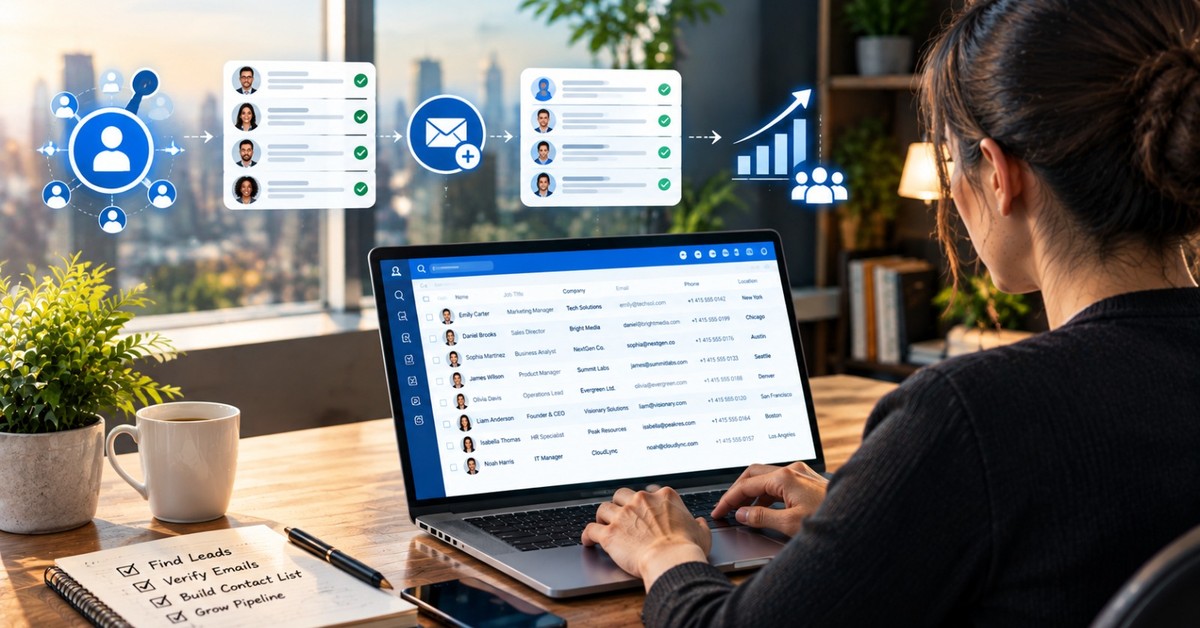
It is the job of researching companies against a client's target profile, identifying the right decision makers, collecting and checking their business contact details, and delivering the result as a structured spreadsheet or table on a schedule. It is sometimes advertised as list builder, lead list builder or data extractor. Outreach is normally a separate role.
Can you really build 500 to 1,000 verified contacts a day with free tools?
No. The published free allowances of the tools these listings name add up to roughly 275 credits a month between them, against a requirement of 10,000 to 22,000 a month. That is 36 to 80 times short, and one of those tools separately caps free users at selecting 25 records at a time. The claim is not ambitious, it is impossible.
Is contact list building the same as lead generation?
It is the research and data stage of it. Lead generation as a whole usually includes outreach and follow-up, which is regulated and measured differently. If a listing bundles both, you are being hired for two jobs and should price it as two.
Can I export leads from LinkedIn Sales Navigator to a spreadsheet?
No. LinkedIn's own documentation states that it does not offer the option to export account and lead information from Sales Navigator into a CSV or XLS file. The only sanctioned route out is a CRM sync available on a higher tier. Any tool that offers you a CSV export is operating against the platform's terms, and the consequences fall on the account used.
Do I need coding skills for contact list building?
No. Spreadsheet fluency matters far more, particularly text functions for normalising domains and the habit of deduplicating on the domain rather than the company name. Coding is not required at any level of this work.
What does it pay?
Figures quoted in career articles for this role are mostly attached to an advertisement that states no salary at all, so treat them carefully. The useful step is to convert any offer into a rate per contact using the quota. Skill-defined enrichment roles advertise materially more than volume-defined list building ones.
Can beginners get contact list building jobs?
Yes, and it is one of the more accessible remote entry points, because a short sample demonstrates competence directly. Build thirty rows with honest status labels and a source column, and apply to roles that describe the work rather than a daily number.
Is this a good route into sales?
It can be, because it teaches target profiles, decision maker mapping and the tools that sales teams run on. The usual next steps are lead generation specialist and then sales development. The quieter and often better paid route runs through data and CRM work instead.
People Also Search For
- Contact list building jobs remote
- Lead list builder job description
- Data extractor job meaning
- Apollo io free plan credits per month
- Can you export leads from Sales Navigator
- How many leads per day is realistic
- List building portfolio sample
- Remote lead generation jobs Pakistan
More Job Guides
- B2B Lead Research Jobs — the research craft behind the list, and why a verified email often is not.
- Lead Generation Assistant Jobs — what these roles pay in Pakistan, and the outreach rules once you start sending.
- How to Find Lead Generation Jobs on LinkedIn — the titles that surface vacancies, and the tools that get accounts restricted.
- Remote Data Entry Jobs — the adjacent role, and how to spot a scam listing.
- Remote Jobs in Pakistan with No Experience — realistic entry points and what they pay.
- Online Research Assistant Jobs — the wider research job market, and the advert pattern to refuse.